Breakin’ The Chains… of FCC Censorship, By Chris Derrick – Sympathy for the Devil #6
January 19, 2012 Chris Derrick 0 Comments
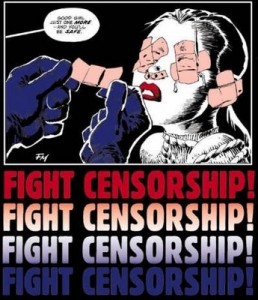 It’s been around 30 years since the high court of the United States last addressed the concept of what is “indecent” for broadcast TV. And the potentially aboutface legal case — FCC v Fox, which is up for debate by the Supreme Court Justices, as of Tuesday January 17, 2012 is doing just that. This is a HUGE deal for the entertainment community (not as big as SOPA & PIPA, but pretty big), because of the flight of quality programming and viewers to cable (particularly pay cable). What’s at stake by the FCC band is just baning foul language from the Big 4 broadcasters, but rejecting altogether more potent and edgy behavioral content (ie that big time dirty word in Washington – sex), and perhaps violence as well.
Many people claim that the FCC has been practicing censorship, and perhaps they are, because the FCC’s concern cannot be about the affect of content on impressionable minds (video games and most hip-hop is chock full of more hang-ringing inducing explicit content), but that certain political constituencies (Evangelicals and others who embrace outmoded Puritanical values under the nomme du guerre: Good Christian Value) will be offended (they can always turn the channel, there are 499 other ones, right?) and then complain to consumer product companies who advertise on TV (and these people don’t always make the right moves though, remember how Lowe’s fucked up with that reality show about the American Muslim family?).
If Fox wins this suit, (which stemmed from when Cher and Nicole Ritchie dropped some “f-bombs” during a TV broadcast back in 2004[!]) and the FCC is actually stripped of some (but not all) of its antiquated broadcast oversight powers to dictate TV content, it’s unlikely that we’ll immediately see shows like Boardwalk Empire, Justified or Game of Thrones on NBC, ABC, CBS and Fox this coming or the next two Fall TV seasons because the executive offices are populated with number crunching, risk-adverse suits who don’t have (or haven’t flexed) the taste and necessary boldness to choose the most challenging material for TV broadcast. In addition, the best stuff on TV succeeds in a business model that is NOT a complete slave to consumer product/highly corporate ad dollars.
For a long time the Broadcast networks have been complaining that they can’t truly compete with cable in terms of quality content (which is a damn lie, see CBS’ The Good Wife and you’ll see a great show that rivals any scripted show on TV), because cable lets the creators show tits & ass, drop f-bombs with a cavalier attitude, and depict explicit brutal acts of violence and sensational sex. This is partly the case, but great writing is characterized by the fact that it is challenging and doesn’t appeal/sit well with the lowest common denominator. Broadcast TV, by its very nature, assumes that it has to appeal to as many people as possible, thus watering down any so-called intellectually challenging content (there a few exceptions that I could point out, but I’m not going to… we both know what those are).
What’s not part of the full discussion about cable’s ability to distribute arguably more creative and definitely more dynamic program is the business model. Cable doesn’t depend entirely on ad dollars to pay for their shows; it takes piece of your monthly cable/satellite fee to fund a good portion of the programming… which also air more than once, thus generating more revenue. So ultimately ratings don’t mean as much, they are important, don’t get me wrong… but can you name then the last cable show that was cancelled after only two episodes? The concept of narrow-casting is what makes AMC a successful basic cable drama programmer, it’s what makes USA successful (although nearly all of USA’s shows could be on its sister network, NBC, and they would be dull unless they were 10pm shows; more on that later) and it’s what makes F/X successful.
Also, the Big 4 Broadcasters fuck up to high degree by keeping the Central Time Zone as factor in how they program (a relic of the days of radio!), in that the prime time shows aren’t delayed. Why is this important? Because many shows that want to show a woman’s ass or string together a bunch of rage-fueled expletives or have sadist violence can get away with it at 10pm, when a large chunk of America is asleep or winding down for the night. Do you remember back in the early 90s when NYPD Blue showed a man’s naked ass on TV? ABC got a lot flak from viewers in the Central Time Zone because NYPD Blue (incidentally the Red States fall in the Central Time Zone, where so-called good Christian values carry a lot more weight than on the coasts) was 10pm show in New York and LA, but a 9pm show in Texas… and guess where those, “well, I’ve never!” and “how dare you?” complaint letters came from? And those self-same sob sisters, grandmothers and evangelicals bent the ear of not just the TV broadcasters, but their overlords — the consumer product companies that advertise on TV and effectively write the checks.
So you see, even if the FCC gets stripped of its power to censor content, there are other dynamics in play that will prevent the Broadcasters from competing the way they claim the need to.
Also, cable gives its creators a chance at telling more compelling and dynamic stories by committing to a full 13 episode season, and then airing it in its entirety. Take a show like NBC’s Prime Suspect; this show stumbled because in the first few episodes the show tried to be too referential to the original BBC show that starred Helen Mirren; the core of the show — the bristling dynamics between the female homicide detective and her completely male department – felt strained, and the show was already slated for cancellation by episode 3 or 4; however, once the show got past that feeling of trying to please or do justice to the BBC show, it really started to take off with some interesting cases.
Yet all the episodes could have been a lot more trenchant and disturbing (as they are on TNT’s Homicide, which originally aired on NBC before the Leno Primetime fiasco); particularly one about a rich alcoholic mother who bludgeoned her son to death, the kid from upstate whose parents were murdered in a NYC hotel room or the struggling mother of three waitress who reluctantly agreed to do some porn work and then was rape in the audition – these three episodes were masterfully written, yet you could tell that they could have pushed the envelope are little further, but probably got notes from Standards & Practices putting the kibosh on the potentially more disturbing imagery – let’s face it, urban crime isn’t pretty, so why do we kid ourselves with many of their extent of what can be shown in these dramatic portrayals?
Prime Suspect should still be on the air, and if it was on TNT or F/X it still would be.
Ultimately, I’m for HBO and Starz style programming on any channel that wants to make that role of the dice. Why does there have to any chains and shackles put on creative content?