The Notes Call, by Chris Derrick – Sympathy for the Devil #11 | @MDWorld
March 8, 2012 Chris Derrick 0 Comments
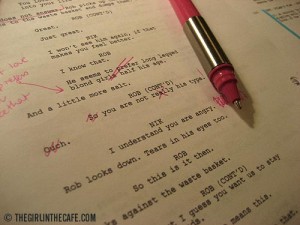 A few weeks back I posted a column about finishing the first draft of a long-gestating (although not too long in the actual writing) screenplay, and how much of a relief it is to type “fade out.”
So what happens next?
Since we’re rep’d my lit managers, the draft went over them for the review and feedback; their feedback falls under the rubric of THE NOTES CALL, an integral (and very much maligned) part of the Hollywood Creative Process. It’s maligned, because writers are getting notes back (typically) from people who don’t know or understand the writing process (and it some cases the basic tenants of storytelling), and who are usually paid to give their opinion (it should be known that they’ve risen through the ranks by having an opinion that enough others liked or have maverick opinions that turned out to be spot-on enough times that their taste has attaied gravitas based upon actual proof of success).
Once you decide to pry your fingers away from the keyboard and turn in your script to whoever has to “approve” of it, you’re on pins & needles waiting with a sense of anticipatory dread (“what are they going to find wrong with it?”, “are they going to say anything good or have positive critique? Or just shit on me and it from page one on?”) about the result of your communication (or failure to communicate). The worst is when you wait a long time before you hear anything.
Why is this most maddening? ‘Cause in Hollywood many times people will be rude chumps and not only not get back to you about a script, but also avoid your calls (until you get the hint) if they didn’t like the script. Better to be an immature punk than get on the phone and give a writer bad news.
Not everyone is like this, but a lot of soulless people are. And Hollywood is FILLED with soulless people.
Many people say, “don’t take it personal”, but that’s a bullshit statement because it IS personal to the writer. He or she spent a consider amount of time writing (and therefore not doing absolutely anything else) and poured some of their soul into the page. If you’re ‘bout it-‘bout it, then you are shaving off bits of your emotional reserve and pimping it to the page. At worst, “running a train” on your work is, at least, something… which is decidedly better than nothing.
The Notes Call should be viewed as a litmus test of your written communication abilities and a validation of your proof of concept – executing the idea determines if the concept is worthy of revisiting (because as any writer worth her salt knows, the writing is in the re-writing).
Execution is the true mark of a professional.
The problem with The Notes Call is that you, as the writer, have given away a great deal of your creative power/ownership/vision to someone else to validate. So it is HIGHLY important that you have a great deal of respect for the person who is giving you notes (the tough thing is when you’re getting paid for the writing, and you discover during the Notes Session that you don’t or no longer respect the person giving you notes).
The Notes can be revealing of your shortcomings in that draft (or as a writer in general, and that definitely sucks), but the first Notes Call and how you handle it also sets the precedent for the creative relationship and who’s in charge. How (and if) you execute the Notes effectively (determined by if the script’s emotional impact is elevated) is the crossroads in the relationship.
Our managers don’t work for us, they are our business partner/ally (contrary to what many people say or think or believe), and in most relationships the balance of power is constantly in flux.
Having not worked in TV, I don’t know how the Notes session goes in that format, but since another writer (the showrunner) is the person who you’re trying to please before going to the network/studio bosses, I’m going to assume those Notes sessions aren’t as gut-wrenching.
However, having worked in the feature film world, many times the so-called critical notes are based on the peculiar taste of the producer (and/or director and cast, if they have script approval); you just have to hope that they are. There are more than enough books relating anecdotes of behavior and attitudes that you’ll encounter in the feature film world.
Sometimes the producer is trying to flex and is giving you notes just to see if, how and when you’ll cave, before standing up for your work and your integrity. Those types of mind games are part of the journey, albeit that’s a journey you want to stop and go home as soon as you can – with a check and your reputation still intact.
Many times development people want to “justify” their position, so even if they don’t have anything truly constructive to say about the script, they want to put their fingerprints on the script and mold it to their tastes. Plus, they have to go to bat for the script with their boss(es) and they don’t want to expend their creative taste capital without making sure it’s to their liking.
See the thing about movies is, the Powers That Be don’t go ahead and greenlight the best version of the script, they greenlight the script that enough people like AT THAT POINT. This is critical in understanding how the game works.
So you’re probably wondering… what was the result of our Notes Call?
I would say it went very well, a hiccup in the presentation of the main character, but that’s not a difficult fix (after thinking about re-envisioning the character intro for a week), and then some revising of the First Act Structure to elevate some of the “punch.”
We turned in the polished version of the First Draft last night. There were things that we talked about that we neglected to put in the first draft that will need to go in the second draft, but that’ll wait until we have the next Notes Call.