Visual Panache, by Chris Derrick – Sympathy for the Devil #15 | @MDWorld
April 26, 2012 Chris Derrick 0 Comments
 Do you watch TV?
Of course you do.
Do you watch movies?
That goes without saying.
Can you successfully argue that TV has surpassed most movies (produced in the United States that is) in terms of storytelling and dramatic entertainment experience?
… Yes, you can. Unfortunately.
Okay, so where am I going with this, as this argument isn’t exactly a fresh-from-the-oven point?
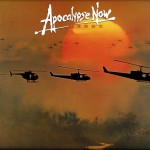 I’ll give some context. A few weeks back I was having a heated (yet playful) argument with my manager about the power of the photographic image and that is what is superior in cinema, and it is what cinema is all about. My manager countered that tired argument that story is king, that story is what draws us to the movies. I had to vociferously disagree, because great storytelling is required for any dramatic medium where entertainment is the prime undertaking – novel, short story, oral story, poem, stage play, TV or movie – all need a great story (which includes dialog and character); but the photographic image is what enables cinema to transcend. I exampled APOCALYPSE NOW! and he claimed, “I love the smell of napalm in the morning” (and the other great bits of storytelling) is/was the reason why we love that story.
My counter to his counter was that that the hallucinatory, cascading super-imposed images Vittorio Storaro majestically captured on the anamorphic 35mm celluloid unspooling over The Doors’ “The End” in that arresting open is actually what sucks us in and keeps up riveted to our seats as we follow Willard on his journey up the river. As an adaptation of Conrad’s Heart of Darkness, the screenplay isn’t exceptional… but how Coppola visually tells it with those optic nerve-burning images IS what makes that story stand out, resonate and stick with us like a bad relationship – it shapes the way we look at all cinema afterwards.
Conversely, these days if you want a compelling and depths of humanity-plumbing story, then TV is where you’re going to find it. Screen scribe (and recent creator of TV’s “Missing” starring Ashley Judd) Gregory Poirier said it best in a recent issue of Written By, “Movies have become, for the most part, a vast wasteland. Television is where good writing is nowadays, while film has taken a spiral downward. Compare “Justified”, “The Walking Dead”, “Shameless”, and “Dexter” to the last four mega-budget studio movies released. Makes you wan to stay in and watch TV, doesn’t it?”
In the past decade, movies haven’t become more like TV, but TV has become more cinematic in terms of camera work/composition and lighting. Yet, the by-necessity production schedule (usually 7 to 9 days to shoot a 55+/- page script for an hour drama compared to 40 days to shoot a 105 +/- screenplay) and budgets ($3m give or take for most TV episodes, whereas you’re looking at $70m for most movies), TV has more effectively honed in on the dramatic instead of the spectacle (which too many movies have become these days). With budgets that would a substantial amount of a 3rd World Country’s annual budget, you can pretty much do anything in the movies… but curiously stories that resonate seem to be an afterthought for most movies (Studio and Indie alike). Almost as if there is an inverse scale, the more money spent the less compelling the story tends to be. There is a sweet spot, but it’s hard to obtain. And movies no longer carry the culture weight that they used, in terms getting people to talk about them… whereas the zealotry that arises when you talk about shows like “24”, “Lost”, ”Firefly”, “Mad Men”, “House”, “Burn Notice” is quite intense.
Yet, the impact of the photographic image is tucked away in a TV show. Most hour dramas establish a visual “look” in the pilot episode (when they do have more time than when shooting the weekly season episodes) and stick with that look throughout the life of the series. It is practically impossible to deviate from the established style regardless of the story content (this is one of the great missed opportunities in TV, but I understand why it’s the case).
Also, ANY writer in Hollywood will tell you that movies are a director’s medium, where as TV is the writer’s – for reasons we don’t need to go into here, but it’s quite obvious as to why that’s the case – the director’s “vision” has to supersede everything on a movie. TV dramas & comedies rotate directors in and out, and they must serve the “vision” of the showrunner – always a writer – not the other way around. Even when so-called “star directors” come in and direct an episode of TV that episode bears the mark of the showrunner’s vision, not that director. A classic example is the episode(s) that Tarantino directed of “CSI.” Everything about Tarantino’s visual style was absent from those episodes… we might have turned in because of the novelty of Tarantino doing an episode of TV, but make no mistake it wasn’t going to be “CSI” mashed up with PULP FICITON!
Shows like “The Wire”, “Breaking Bad”, “Mad Men”, “Battlestar: Galactica” and “Sopranos” all extended the boundaries of what type of stories could be told on TV, but what images can you remember from those shows the way that you remembers images from SE7EN, MOULIN ROUGE, SAVING PRIVATE RYAN, THREE KINGS and SHAWSHANK REDEMPTION… those cinematographers extended the boundaries of what was visually possible. Not to say that the DPs on a TV series are hacks (far from it), but they’re ability to artistically express themselves is hampered by the short schedule.
On a certain level it is extremely disappointingly and sad that film doesn’t get a chance to tell highly dramatic stories (outside of the difficult-to-get-financed Oscar-caliber films that come up in the last 6 weeks of the year each year), because the films that transcend are usually films imbued with a sense of artistry and consideration to stirring complex emotions without easy ways out and pat endings… two things that anathema in today’s Hollywood.
Also, today’s video technology allows for home theatres to rival many a theater-going experience, but no HD TV show will have the indelible images of cinema. Yet, getting me to come back and watch another episode of say, “Game of Thrones” or “The Killing” is a lot easier to do than go to the theater and watch a movie. I know that entertainment value of my favorite TV shows, it’s an odds against the house crapshoot that a movie is going to be fulfilling.
The spiraling production budgets for movies make it so intellectual stimulation and intricate emotional is nearly out of the question.
Oh, and here’s something else that we can throw into the debate… content that would get smacked with an NC-17 rating by the MPAA might (I say might) get a MA-SLV rating on TV, yet still get full advertising on TV, radio, newspapers and billboards. Something about the potency of the visual image that’s going to be shown 40 feet across still warrants a didn’t level of review (even though I think most NC-17 rating are bullshit, because it’s mainly used to censor sexuality and violence is hardly a factor is pushing a rating to non-commercial status).
However, at the end of the day people still quest for the glory of doing a movie and hoping that a movie will stir them emotionally. We’ve been conditioned to believe that movies are the pinnacle of the visual entertainment experience. I wish the corporations that run Hollywood and the MBAs who develop for them recognize that they’re tarnishing their product on a regular basis and debasing its value.