WHO ARE YOU? CRISIS OF THE ID IN “MAD MEN”, by Chris Derrick – Sympathy for the Devil #18 | @MDWorld
May 24, 2012 Chris Derrick 2 Comments
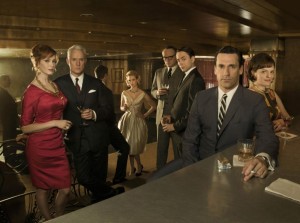 I wasn’t sure what to expect when “Mad Men” returned this season. I had high hopes, because the last season was just outstanding and the finale was impressive. But that’s not what keeps me riveted to the screen when we visit Sterling Cooper Draper Price. It’s the unrestricted storytelling that Matthew Weiner and his crackerjack writing staff enjoy and delight in giving us.
Sometimes storytelling pyrotechnics enthrall me more than they perhaps should, but the depth of the characterizations is still paramount.
As I was preparing for the most recent staffing season, I was developing some concepts on how to discuss some the shows that I’m passionate about and why. As I’ve been watching “Mad Men” the night it airs (one of the few shows that I can actually do that with), what struck me about the show is that it’s all about identity.
Every character continually struggles with their identity throughout the series. It all stems from Don Draper not being “Don Draper”, and it was driven home again in the recent ROSHOMON episode from a couple weeks back, when Meagan smacked Don with a comment about his mother in the Howard Johnson’s. Now think about it…
Roger Sterling craves for the gravitas that was afford to him when Sterling Cooper had Lucky Strike’s business; that defined him at the agency, and without it (or a similar high-profile, high-value account), Roger just aimlessly comes to work to get away from his wife (well, ex-wife now) and drown whatever skills, talent and work ethic he used to have in top shelf liquor.
Pete Campbell is absolutely dissatisfied with his position as father/husband and he demands to be considered as a serious member of the firm as he begs for respect (when he fails to realize the respect is earned). His recent bouts at infidelity just confirm that the cage he’s in is eating at his soul.
Peggy’s identity is tied up in being a copywriter, and when Meagan tosses it away to return to being an aspiring actress, how psychically devastating is that to Peggy? She’d be stuck as a secretary (something she can’t excel at or even fake taking pride in that work). Her decision to cohabitate with Abe, while not the marriage that she ultimately wants, is surely a sign that she needs more than what the office can give, but can’t articulate because she needs that affirmation more than anything.
Meagan was guilted into tossing aside her career at the agency by her communist (!) father. And she battles to mesh her Canadian free spirit with a Heartland farm boy husband who’s masquerading as a sophisticate.
Lane Price lost his sense of identity when he came to America, witnessed by his lusting after that Black waitress in the previous season (to which his pops Beat. His. Ass and smacked him around with British racism and classism!). This season Lane has attempted to extend the boundaries of his managerial position to near comic effect.
Betty, originally, had no real identity outside of being Don’s forlorn wife, and now as Mrs. Henry Francis is she better off? Hardly, she’s become corpulent, unrestrained and vindictively mischievous, which is perhaps who she really is. But it’s like she can’t be who she wants to be, because she has no idea who she actually is. The men (which includes the pressures from Madison Avenue) in her life are constantly and unavoidably defining her, which she rebels against (covertly though) and lashes out when ever she gets the chance (as who ever calls her on her bullshit?).
Sally can’t fuqing stand being a young, defenseless/helpless girl; she’s perpetually demanding to be treated like a young lady and then she can’t stomach the adult world when she inadvertently spies Meagan’s Mom playing the skin flute with Roger’s pipe. I guess she’s not quite ready to be an adult after all (the line tagline for that episode, “how’s the city? Dirty,” was priceless/genius).
Ken Cosgrove (love that name, reminds me of Cogswell’s Cogs from “The Jetsons”) has to hide the fact that, outside of the office, he is a successful writer of sci-fi short fiction, and it’s an irrepressible force inside of him. Even after Roger issues a fatwa and commands Cosgrove to quit, he agrees then just effortlessly selects a new nom de plume and continues with his next creation in the secret sanctuary of his bedroom at night after his wife has gone to sleep. As if he’s the only one who can juggle his identities.
Even back in the early seasons, Salvatore Romano was a closet gay man and his inability to admit to himself who/what he actually was cost Sterling Cooper Lucky Strike when he failed to submit to Lee Garner, Jr.’s erotic advances thus being the knife that would castrate Roger!
A week or two ago TIME Magazine ran an article on the import/use of color in this season to suggest psychological states. This was an interesting article, and critics/scholars endlessly find great fodder for their columns in dissecting cinema and TV. Yet, “Mad Men” is about more than just revisiting the ‘60s with a more critical eye and seeing it as unvarnished as it actually was. Hard-boiled crime novelist revisits the ‘60s through his own contorted prism in his most explosive books American Tabloid and it’s just as revelatory as Weiner’s “Mad Men.” Would be curious to see STARZ do a mini-series adaptation of that book!
As a character study on the pitfalls of identity quest “Mad Men” explores a lot of the ugliness and desperation that we suffer from in corporate and personal life. There has always been some criticism about “Mad Men” not including African-American characters… and to a certain extent that has bothered me, because the 1960s was the ascension of African-Americans out of the pernicious Jim Crow era. But for “Mad Men” to give similar discourse to an African-American character would suggest that we’d see a character that wasn’t “dignified” the way nearly all African-American characters in pre-1970s recreations are portrayed and that might bring too much criticism to the show (see THE HELP).
Weiner and Co. would have to walk a treacherous tightrope in breathing life into an African-American character, because you’d need a character straight out of Ellison’s Invisible Man or some of the rarely discussed elements presented in Autobiography of Malcolm X or the revelatory My Grandfather’s Son (Clarence Thomas’ memoir) to be true to the spirit of the show. Identity for African-Americans is many times was more fluid (remember African-Americans are constantly bifurcating their identity presentation as well as avidly working to define themselves, and not be defined by others) because their identity is, sadly, dictated by the circumstances and environment, not necessary the individual’s choice. I doubt that kind of truth would be handled with aplomb; not that Weiner couldn’t do it (‘cause I think he’s that good of a storyteller), but would he?
He has enough on his plate dealing with the sexism, casual alcoholism and office backbiting.
There’s always more with this came from at ShadowBoxer Cinema or better yet, follow me on Twitter.
George Haberberger
May 29, 2012 - 3:16 pm
I’m interested in what you though of this weekend’s episode. How much has Joan’s identity changed now?
Christopher Derrick
May 29, 2012 - 3:52 pm
I haven’t watched yet!!!
But I will later today and toss in my 2cent thoughts, cool?