You’re Killing Me, said the Cinema-Goer, by Chris Derrick – Sympathy for the Devil #20 | @MDWorld
June 28, 2012 Chris Derrick 4 Comments
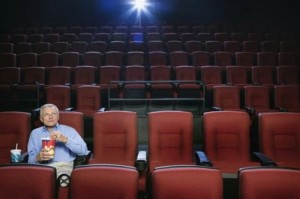 In the last couple of years the price of movie tickets has risen to what many would call prohibitive levels (thus encouraging an increasing amount of piracy), and if you look at the Motion Picture Association of America’s attendance numbers, you will see that cinema attendance IS going down. I’m sure that part of it is because going to theater costs too Goddamn much. I balked supremely when I went to the Mann Chinese Six (not even the big theater) to see RED TAILS — $16! Still had to pay for parking, popcorn and the Cherry Icee, so that was another $10! Compared to waiting (does it matter when you want a film anyway) and watching it from Red Box, what’s that $1? And Netflix streaming is what? $8 a month? At 720p quality to boot!
However, going to the movies is a singular experience; that huge-ass screen has a religious impact on us (why else do you think people get so heated and passionate about films they love or hate?), and yet the industry seems to be hell-bent on finding ways to limit those who can enjoy worshipping the cinema gods.
Let’s take a look at the most recent case of an attempt to destroy the temple. Filmmaker Peter Jackson recently debuted portions of his upcoming HOBBIT movie at 48 frames per second, as he feels that at the faster frame rate the audience will see the imagery, production design and costumes better at 48fps. Oh, it’s going to cost you probably as must as 3D currently costs to see the 48fps projection, and then you gotta add on the 3D presentation as well; so maybe $25 for a single solitary ticket to see THE HOBBIT in 48fps. No popcorn, no soda, no candy, no date!
Here’s the thing, the vast majority of people WILL NOT see Jackson’s (or any filmmaker’s) film in the theater, they’ll watch it on the their 60-inch flatscreen LCD – which doesn’t display in 48 fps, so why force the hand of the exhibitors to upgrade their digital projectors to accommodate this unproven (to be profitable and appreciable, that is) exhibition technology?
History has shown us that the general public either doesn’t care too much about video quality or is indiscriminate to quality video to the extent that they will pay more for the cinema experience (remember the Betamax, it had superior quality audio and video, but it cost more than VHS and lost out in the commercial marketplace… along with a few other licensing missteps). Sound is a different matter all together, people do seek out Dolby Digital or DTS theaters.
3D projection (and let’s not talk about 3D Imax) already stresses one’s wallet and there is hardly any experiential benefit (it’s marginal at best, even in the best of 3D-originated films). In fact most people complain about the quality of the 3D and especially with 3D converted films – but the films keep getting distributed and at the higher ticket prices.
Since we watch movies and TV on the same screens – predominantly – even those small-ass screens like your iPhone or Android or iPad or Kindle, the demarcation line has effectively blurred – it’s all filmed entertainment, consumed at 22m, 44m or 90 to 110m chunks – take your pick. Increasingly the 44m form of filmed entertainment (i.e. the one-hour TV drama) is the bee’s knees for compelling storytelling, unforgettable characters and passionate writing – at a mere fraction of the cost of the 110m form of filmed entertainment.
It appears that the audience has a difficult time finding the non-over hyped blockbusters to support at the multiplex, and one wonders how much more audience will be lost as the ticket price continues to skyrocket.
The Internet age and the global financial crisis have altered the economic fundamentals of how the nation – consumer-driven as it is – will spend its hard-fought-for dollars. We’re no longer a wealthy society, yet we still want to believe that we are and still desperately need our filmed entertainment to aspire us or just pacify us. Speaking from a strictly economic point of view, it doesn’t make sense to consume the 110m chunk of entertainment, when I could consume the 22m or 44m for a fraction of the cost… and the entertainment value, by in large, is arguably no different.
Unless you factor in the expansive and emotionally expressive scope of the cinema screen and the power of the widescreen image (I’ve talked about this in previous posts) to tell a nuanced story that doesn’t necessarily translate the same way when played on a smaller screen.
Is it conceivable that the high priests of the church of cinema will ask the parishioners to tithe too much, thereby accelerating/promoting the continually growing revolt/reformation?
A sizable number of 3D films have been released in the recent roll out of the digital incarnation of the antiquated technology, and one could argue that 85% of 3D cinema is NOT better served in 3D over 2D. So can you imagine what 48fps presentations will yield? Don’t put it past the multiplex owners to find every means possible to slaughter the golden egg laying goose.
But the thing is, I’m sure that 48fps LOOKS GREAT! Back in the early 1980s, special effects pioneer/guru Douglas Trumball (2001: A Space Odyssey, Blade Runner) established a presentation technology called Showscan; it recorded and displayed at 60fps (on 65mm film for heighten definition, no less). It was rolled out, most notably, in the Back To The Future amusement park ride at Universal Studios (that’s why the image looked so damn good). Movement and color reproduction was startling in its clarity and accuracy – thus improving the suspension of disbelief. It never caught on to wide spread cinema use – too costly, and the cost would have been passed on to the consumer. So do we need this kind of presentation technology, if it threatens the wide-worship of the silver screen?
The world is always a sadder place when a movie theater dies, and sure the concept of the cinema will exist in the future, but will it be a niche experience for the 1%, like going to the opera? And some of you might like opera, I do.
mike weber
June 29, 2012 - 5:25 am
Actually (to hit one minor point) having had both VHS and Beta machines simultaneously (to facilitate trading), Beta was not particularly superior to VHS at the point where most consumers would see them.
They had roughly the same picture quality on first-generation (off-air or pre-recorded) material, but VHS lost quality more quickly as you copied and re-copied.
And as for audio – except during the period that Beta HiFi was on the market and VHS HiFi wasn’t – no significant difference.
Mike Gold
June 29, 2012 - 11:58 am
Theaters are going digital because somebody equated going digital in 2012 to going audio in 1927. The studios save an unbelievable fortune in making prints (now called “copies”) and in shipping same.
There’s this beautiful old-time movie palace on Chicago’s northwest side called The Patio. After a decade of no-attention, the joint was thoroughly restored about a year and a half ago, except for the pipe organ. I think they’re still working on that. Now they’ve got a Kickstarter campaign going for a digital projector. Otherwise, they’ll never be able to run new movies and bring in enough coin to support the place and run the festival stuff. As The Theatre Historical Society has pointed out (http://theatrehistoricalsociety.wordpress.com/2012/06/28/patio-theatre-chicago-status-of-digital-projector-fund/) “Second-run theaters who can’t afford the $50,000-$100,000 to make the upgrade find themselves with the prospect of having to shut their doors, a problem that’s particularly affecting rural theaters.”
If not for these few remaining movie theaters scattered all over this nation, I’d have little non-professional interest in ever going to a movie theater again. Fifty bucks for two people to watch a bunch of commercials and listen to people jabbering? Eat me.
Chris Derrick
June 29, 2012 - 3:10 pm
Mike Gold, I’m not wringing my hands over the conversion from film projection to digital projection (which is not yet the standard), but over the fact that the 48fps UPGRADE requires an additional expense to the multiplex owners — which they will pass on to us. Even though they’ll recoup the investment after about three months, but will prices go back down? Hardly.
Movie-ticket pricing is notoriously sticky.
I’m going to get the skinny of the The Patio’s Kickstarter. But see it doesn’t stop at digital projection, you upgrade to 2K for $100K, and they want you to upgrade to 4k with 48fps capabilities for another $50K to $100K. And then what’s next in 5 years?
I know that the price (and viability) of film prints is as dead as Blackberry.
And you’re right, the $50 expenditure doesn’t equate to a better experience. Hence, the blurring of filmed entertainment’s demarcation lines — 22m, 44, 110m chunks…
Mike Weber, I used my Betamax up until 2006, and I recently transfered from OOP movies that I recorded from LaserDisc to Beta that have a better image than VHS of the same era. I always noticed that Beta was sharper (and technically it is, VHS 220 lines of resolution, Beta 280 lines of resolution.. that’s like a 20% difference; you’re right about the audio though…). But these underscores my point, most people might not be able to discern at 20% sharper image… and while I don’t know how much improved the 48fps image is compared to the 24fps image, but why not go to 60fps like Showscan?
Mike Gold
June 29, 2012 - 4:38 pm
Let’s just stick an AV input chip into our brains and be done with it. I’ll make my own popcorn.