Sunflowers in the Land of the Sun King…by Whitney Farmer – Un Pop Culture | @MDWorld
July 25, 2012 Whitney Farmer 5 Comments
 Whitney runs a rock music venue on the beach in L.A.. She has an MBA, and a new passport.
Next week, I leave for France. Somewhere south of Paris, I will meet up…er…rendezvous…with the community of gypsies that I met last Fall. They want our group of six from Surf City USA to go with them and tell people what we know about God, and to help them figure out how to get their children the education that they need.
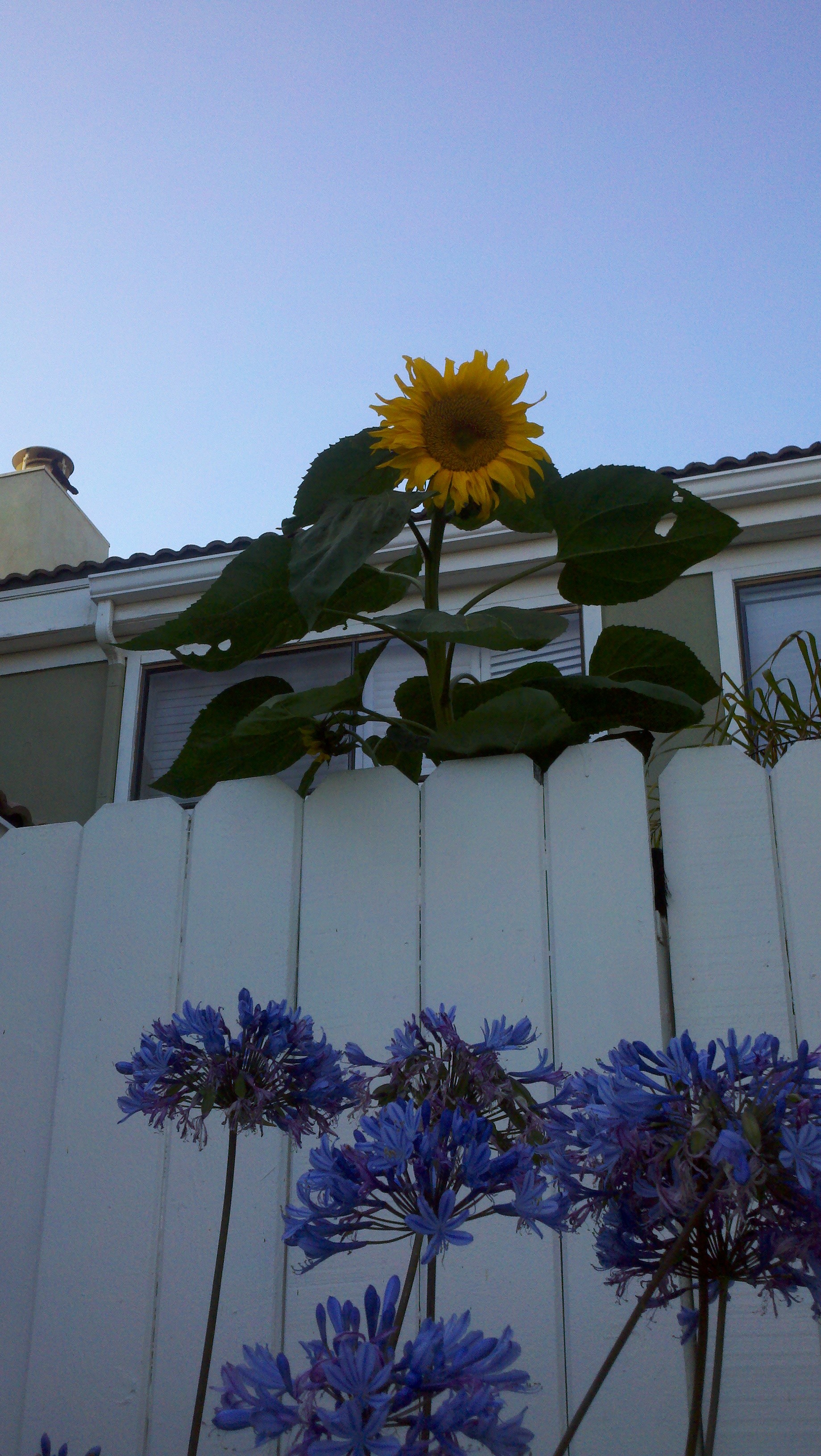
I was told that they have sometimes set up their camp in a field full of sunflowers. When I heard that, it caught my attention. This year, for the first time since I was a child, I planted a garden from seeds. One packet was sunflowers. And from all of those that grew, one became magnificent. It is maybe 10 times the size of its littermates, and its face reached eight feet towards the sky before it bowed it as if humble and bent into our neighbor Frank’s front courtyard. I’ve apologized a couple of times for violating his property rights, and each time Frank tells me that he thinks the flower is beautiful and to let it do what it will.
That got me studying sunflowers. I learned that the sweet bold face that you see isn’t one blossom, but hundreds, organized in perfect mathematical order called the Fibonacci sequence. In this design, the first two numbers are zero and one, and then the succeeding numbers are the sum of the previous two. 0, 1, 1, 2, 3, 5, 8, 13, 21, 34…
Brought from the Americas where they were cultivated by my First Nation ancestors back to Europe by early explorers who became conquerors, sunflowers are cherished for their glorious appearance as well as their usefulness. Their oil is used in religious ceremonies to represent the presence of God: soothing, rich, nourishing, and healing.
The promise of glorious life represented by sunflowers was why they were planted on the graves of Nazi soldiers. This became the image that haunted Simon Wiesenthal as he was ushered from his standard work duties at a concentration camp to the deathbed of a dying Nazi who asked to have ‘a Jew’ brought to him so that he could confess his sins. The young Simon walked passed a Nazi cemetery on the way, covered with sunflowers. In that encounter, the soldier told of an atrocity that he had committed, and he asked ‘the Jew’ for forgiveness. Silent, the young Simon left without giving it. This began a haunted quest that ended in his work “The Sunflower: On the Possibilities and Limits of Forgiveness.” Seeking justice by first documenting atrocities became the purpose of his life. Unlike the illiterate gypsy people – of whom estimates between 250,000 and 1.5 million were victims of the Holocaust but whose attempted extermination only began to be officially acknowledged in 1982 – the Jewish victims were never silenced because their surviving champions knew how to read and write and could tell the world what had happened to them.
Last week, my Dad was in the hospital after hemorrhaging. As he was getting settled into his room, (number 007 which Mom loved), the intake nurse gave him a bag of personal items to help him be more comfortable. On the outside of the bag was a picture of sunflowers.
Next week, I hope to begin to find out how to bring comfort. I hope to discover how I can help give people the power to read, and because of that the power tell their stories and learn truths. I’m hoping it isn’t a coincidence that I am traveling the same route as those first sunflower seeds to be planted in their land.
And I have been told that any difficulty will be worth it, because there is nothing better than a cup of gypsy coffee.
Quote of the Blog, from Harriet Beecher Stowe: “Flowers have an expression of countenance, as much as men and animals. Some seem to smile. Others have a sad expression, some are pensive and diffident; others again are plain, honest, and upright, like the broad-faced sunflower…”
NOTE: The term “gypsy” is viewed by some as being pejorative and the term “Romani” is offered as an appropriate substitute. The reason I use the term “gypsy” is because they corrected me when I called them Romani. When I asked them what they wanted to be called, they said gypsy. That settled it for me.
Image of my sunflower hanging over Frank’s fence, courtesy of my cell phone.
Martha Thomses
July 25, 2012 - 5:57 pm
Tulips, dear one. My personal favorites. Enjoy France, please. We were supposed to be there this spring.
Jonathan (the other one)
July 25, 2012 - 7:32 pm
When my wife-to-be and I were picking out wedding invitations, we noticed that a lot of them compared love to roses. That seemed inappropriate to us. “Our love is like a red, red rose!” You mean it’s thorny, delicate, and must be carefully tended in a hothouse?
Our love is like a dandelion. Pull it up, poison the ground, try to dig out the roots – it’s going to grow back. Nobody can kill it, no matter how they try. And it grew where it would, without anyone having to plant anything.
Whitney
July 25, 2012 - 11:42 pm
Divine Ms. M –
How about you coming along next time? The first step to literacy is learning to love reading. That’s you kid.
Sometimes it’s good to be contagious.
Whitney
July 25, 2012 - 11:49 pm
Jonathan (the other one) –
And according to Bradbury, when you are ill and sad in the winter, you can sip dandelion wine and drink in sunlight.
Moriarty
July 26, 2012 - 8:58 am
Whitney,
Will you be sending dispatches from the field?
Let me be the first to say “Good Trip.” Man, I wish there was some common French phrase that meant the same thing.
Sunflower seeds, the backbone of Major League Baseball.