Clone #1 and #2, by Marc Alan Fishman – Snarky Synopsis | @MDWorld
December 16, 2012 Marc Fishman 0 Comments
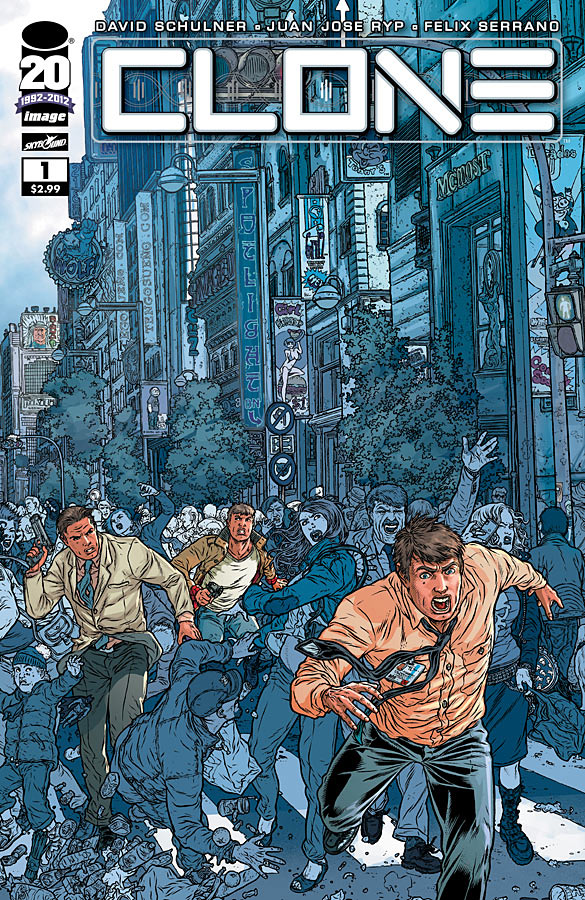 Written by David Schulner, Art by Juan Jose Ryp and Felix Serrano
Clone, as brought to us by Robert Kirkman’s Skybound imprint at Image Comics, is a mini-series that has enough intellectualism to cause me to question why I’ve been such a mainstream whore for so long. DC and Marvel (and I exclude Icon and Vertigo here…) wouldn’t have the balls to produce something so heady. Better than that though? Clone isn’t just a head trip. It’s an action-fueled romp through a slightly exaggerated real-ish world. Let’s open ‘er up and see what we got, shall we?
David Schulner, playwright and TV wordsmith, has taken to the penciled and inked rags to deliver an interesting ‘what if’. Consider issue’s 1 and 2 the cold open, and brief act 1. We’re introduced to our hero, Luke, who it turns out (no surprise given the title…) is a clone. Seems the US of A got a little busy in the 70’s with stem cells. I knew it! 30 some-odd years later, Luke finds out he’s one in a long line (30? 40? 50?) clones all being removed from duty. Of course he didn’t know he was a lab rat. Pepper in the secret rebel battalion whose moral objection to the experiment cause them to fight for the Lukes’ right-to-life… the evil clone Luke’s paid by the government to kill the other Lukes… and add a twist about Luke Prime’s pregnant wife, with a dash of West Wing political intrigue? Wham bam, thank you ma’am.
A cursory glance across Schulner’s IMDB page reveals no big secrets. As a TV scribe, he’s lent his name to several not-quite-smash shows that foretell of his writing style. He’s certainly by-the-book when it comes to his beats. You can practically taste the commercial breaks as he moves from scene to scene. Conceptually, the comic is tight. Taken for what it is—an obvious primer for a to-be-filmed work—we’re not quite out of the woods yet. Take for example the cliffhanger at the end of issue 2. Without spoiling it, trust me… if you’ve watched enough popcorn flicks where the good guys walk away from the giant explosion while looking coldly into the camera? You’ll see the twist a mile away. That’s not necessarily a bad thing mind you, but it definitely takes away the novelty of book down a peg.
Characterization thus far is limited at best. Because of all the moving pieces Schulner has to get chugging, it’s hard to find likability in just about any character across the first two issues. To be wholly blunt? The Vice President’s wife was the only one in 48 pages I had any feelings for. Luke, in as much of a bad position as anyone could be, is too bland yet to be one to root for. He’s Bill Paxton. Or Dermot Mulroney. He’s milquetoast with a bit of apple butter. That butter being the plot spread across his nooks and crannies. Given too, that his own clone(s) are the kidnappers/baddies/ne’er-do-

With that being said, I’ll applaud Schulner’s zeal for the debates he’s trying to spark. By showing us a sci-fi twist so believable, he himself puts it best with the words of the VP. “We opened Pandora’s Box… now we must close it.” It’s a lofty concept that he’s obviously trying to get us to think about ourselves, amidst the shooting and evil-plot-hatching. Does he succeed? Yes and no. It’s a bit ham-fisted two books into it all. Given that this might in fact be just a mini-series, Schulner may be boxed into cramming all his intellectual eggs in 6 or so baskets. Take as a counterpoint a series like Y: The Last Man, which explored similarly heady concepts, but let the mind-gasms come more organically. Given the pedigree of our writer? I’m apt to guess he wants us on the edge of our seat, so he can get in, and get out before we have to do too much noodlin’.
Artistically speaking, Juan Jose Ryp and Felix Serrano deliver a book worth looking at. Ryp’s pencils/inks share qualities of many artists I love—Brian Bolland, Geof Darrow, and Chris Burnham pop to mind. A .01 micron line pretty much coats every centimeter of his page. His panels and pacing, no doubt commanded by Schulner, pack rich details that make even bland talking head pages vibrate with emotion and energy. Ryp isn’t perfect mind you—far to many times an expression, a body, a face, will just seem absolutely choked with line work. His Vice President for example looks every inch a 186 year old man. You could hold pages of the family bible between the folds of his 4 notches of cheek folds . That being said, Felix Serrano delivers a color palate that balances cool and warm elements to move the eyes across the page. His gradation of color is every bit as twitchy as Ryp’s pen, and because of it, there’s a real synergy to the book at large. It’s clear he’s pouring his heart on to the page, and for that, I salute the efforts. They elevate the script numerous times.
Ultimately, I’d recommend Clone for anyone sick of crappy crossovers, tired of epic events, or bored with reeking ret-cons over at the big Two. Taken for face value, Clone is a high-budget mini-series on Sci-Fi thus far. With a bit of slight-of-hand, and an fast moving plot that could turn on a dime by issue three? Clone may just be worthy of AMC.