We’ll Never Turn Back, by Martha Thomases – Brilliant Disguise | @MDWorld
September 1, 2013 Martha Thomases 0 Comments
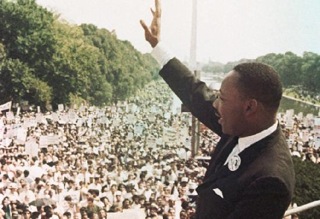 The first time around, I didn’t pay that much attention to the 1963 March on Washington. I was, after all, ten years old. We saw the reports on the news and talked about it over the dinner table. It was my parents fervent belief that, as Jews, we had a special responsibility to stand up for civil rights. Still, it was a few years before I understood the issues in human terms.
As a result, this week’s commemoration of the 50th anniversary of this historic event was an unusual mix of news and nostalgia for me. My own memories were mixed up with day camp.
Still, it is always wonderful to have the opportunity to return to the terrific speech that Martin Luther King, Jr. gave that day. Over the last 50 years, “I Have a Dream” has become such a respected classic that some of us have forgotten its context. The right wing has taken one line – “I have a dream that my four little children will one day live in a nation where they will not be judged by the color of their skin but by the content of their character”” – and used it as an excuse to dismiss the far more radical analysis in other parts of the speech.
For example, this:
“In a sense we’ve come to our nation’s capital to cash a check. When the architects of our republic wrote the magnificent words of the Constitution and the Declaration of Independence, they were signing a promissory note to which every American was to fall heir. This note was a promise that all men, yes, black men as well as white men, would be guaranteed the “unalienable Rights” of ‘Life, Liberty and the pursuit of Happiness.’ It is obvious today that America has defaulted on this promissory note, insofar as her citizens of color are concerned. Instead of honoring this sacred obligation, America has given the Negro people a bad check, a check which has come back marked ‘insufficient funds.'”
Still, the coverage of the anniversary was respectful, if superficial. Dr. King was honored, yes, but over-simplified in the process. Dr. King was certainly a great man, with a brilliant mind, a compassionate heart and the courage to put his body on the line for his beliefs. However, to watch television this week was to think he planned it all himself, with maybe a few bits of encouragement from John Lewis. There were interviews with people who had been at the original march, but no talk about whomever had organized the buses and carpools that brought them.
I get it. It’s easier to cover one man and claim the civil rights movement was some kind of cult of personality than an actual movement. To pit Dr. King against Malcolm X like some kind of popularity contest instead of a passionate debate about goals and tactics.
It’s also easier for the media to see Dr. King as simply a civil rights leader, and slot him into a Black History box. Then, we just have to pay attention to him in February, and perhaps once every 50 years in August.
“I Have a Dream” is an amazing speech, and nothing I say here is intended to diminish its importance. (As if my words could ever be that powerful.) However, it is not the only great thing Dr. King ever said. He didn’t get to 1963 and stop thinking. Congress didn’t pass the Civil Rights Act and the Voting Rights Act and shut him up. Some time later, he angered the Establishment that had come to tolerate him by speaking out against the war in Viet Nam. You can read one of his important speeches here in which he says (among other things):
“There is…a very obvious and almost facile connection between the war in Vietnam and the struggle I and others have been waging in America. A few years ago there was a shining moment in that struggle. It seemed that there was a real promise of hope for the poor, both black and white, through the Poverty Program. There were experiments, hopes, and new beginnings. Then came the build-up in Vietnam. And I watched the program broken as if it was some idle political plaything of a society gone mad on war. And I knew that America would never invest the necessary funds or energies in rehabilitation of its poor so long as adventures like Vietnam continued to draw men and skills and money, like some demonic, destructive suction tube. And you may not know it, my friends, but it is estimated that we spend $500,000 to kill each enemy soldier, while we spend only fifty-three dollars for each person classified as poor, and much of that fifty-three dollars goes for salaries to people that are not poor. So I was increasingly compelled to see the war as an enemy of the poor, and attack it as such.”
By implicitly linking militarism to racism and institutional capitalism, Dr. King changed my life. When I was introduced to the women’s movement and the labor movement and the LGBT movement and the environmental movement, it was less difficult for me to see how these issues also related. Dr. King wasn’t the first American to take note of this (see here), but he was the first to do it in a language that I understood, in real time.
As we celebrate Labor Day this weekend, I hope we will continue to discuss the issues raised by Martin Luther King, and to celebrate his life. While we say nice things about him, it would be even better if we studied the people who worked with him, who influenced him, and who carry on their work today.
And then it would be better than even that if we joined in the struggle.
Martha Thomases, Media Goddess, also has a dream, but it tends to involve breaking into her old office through the tunnels.
Howard Cruse
September 1, 2013 - 8:20 am
When he was in college a friend of mine lived in the dorm room across the hall from the room occupied by Martin Luther Kind’s son. When MLK would come to visit, they would sit around the dorm shooting the bull the way you might with any fellow student’s (unusually interesting) parent. He was a dad, not an icon. That’s an enviable memory to have, I’d say.
Pennie
September 1, 2013 - 4:15 pm
He taught us so much. He stood for so much. I’m proud I was thrown out of school for helping to lead a teach-in based on Dr. King’s peaceful interventions. In the pantheon of true leaders of this country, Dr. King stands tall with a very select few. Thank you Martha.
tom brucker
September 3, 2013 - 6:18 am
George Washington fathered our country all by himself!
On a serious note, I was never radicalized, but certainly was raised to believe in equality. Then,I met Martha, who taught me that by simply living in inaction was a method of supporting injustice. Martha, you know that change begins one person at a time. Dr. King had a broader audience, and perhaps changed thousands at a time, but your contributions are no small thing.
Martha Thomases
September 4, 2013 - 6:05 am
@Tom
*blush*
and smooch