After the Flood – Sunset Observer #30, by Whitney Farmer – Un Pop Culture | @MDWorld
April 10, 2014 Whitney Farmer 5 Comments
 Follow Whitney at @farmer_whitney (Twitter/FLICKR) or farmerwhitney (Instagram)!
Mia the Sun Conure hates earthquakes and flies out of her cage and across the room to get to me when they strike. I leave her cage door open intentionally because I am haunted by the idea that everyone will die during a 9.2 but her…but she is trapped in her cage and can’t get out, so she starves to death.
As a fear item, it is as distinct to me exclusively as worrying that I will give one of my parents a lousy haircut and there won’t be enough time for it to grow out before…you know. So each time before I start, I put my hands on head and pray that I won’t mess up God’s creation and have my sisters be mad at me for-e-ver.
As the earthquakes rolled through us recently, vignettes of how poorly we are prepared were immediately followed by jokes and tweets to make us all feel better. But nothing bad actually happened.
Over the next few days, everything kept moving. By Saturday, I was starting to feel seasick in my living room while I was sitting on the couch. The dogs have stopped eating, and the marble entry way in my sister and brother-in-law’s home is cracked down the middle. Around here to have insurance for that type of damage is too expensive and carries about a 50% deductible. So instead of covering up imperfections, you just verify that it isn’t a sign of a dangerous problem. Fix the crack if it’s necessary for function but otherwise live with it. Unless you are a woman who is dating or are trying to get a job in show business. Then you fix the cracks by any means necessary.
Odds are that each of us will get hit by one disaster in our lives, perhaps only symbolically. If a 3D one arrives, we might have a moment of “That’ll really give me something to cry about…”, but hopefully some survival strategies will be transferrable from our imagined giant slaying and will allow us to overcome.
Preparation in advance is wise if there is a balance between fatalism and paranoia, hopelessness and selfishness. We are born with a will to survive, and the moral heart views our few minutes as fragile treasure. But the moral heart also rests when it decides against survival at all costs. Playing music on the Titanic instead of trampling over a child to get in a lifeboat must have felt glorious on the conscience.
But surviving well is a quandary. There seems to be limited wisdom to give to those who have made it through the storm. The common expectation is that there should be only celebration. But while other kinds of remembrance can make joy a natural consequence, escaping death during a time when others did not often doesn’t lead to a happy ending.
I hope to see “Noah” this weekend, despite the controversies. I guess in the movie he fights to keep people off the ark? Um…yeah…that isn’t biblical. But that Noah got drunk as soon as he was able to reach dry land is accurate. And that he fell into a drunken rage and cursed one of his sons is as well. The 100-year-old kid might have deserved it, but good decisions are rarely made intoxicated. And right or wrong, a curse spoken by a father has a tendency to stick.
What must have Noah felt? He heard God’s voice, but he also heard the voices of those who realized their mistake too late and beat on the outside hull as their mouths and nostrils filled with the flood. Noah and his family were safe. But soon afterwards, Noah did what some warriors do after surviving a war: He got passed out drunk and cursed his family. Life had been preserved, but the landscape where he now walked was completely alien.
Over the desolation is where God stretched the rainbow, taking the blinding unrelenting white glory of the sun, sending it through broken prisms of a water logged atmosphere, and breaking it into beauty. The light no longer was impossible to withstand as it drove straight into the earth. Now, it had been cooled as the colors were separated out, and bent to touch rather than to pierce.
As I age, I am learning to understand the word “awe”. From it, we derive the word “awesome” which is assigned most often where I live to things that are not. And yet it almost always thrills me to hear it being used, even if it is spoken about a new color of nail polish.
But from “awe”, we also are given “awful”. This is the wonder and fear that must have struck Job before he said, “Blessed be the name of the Lord…” before falling silent in the misery that happens before the breakthrough. It must have struck Noah as the voices of his mockers went silent in death, or the Hebrews as the walls of Jericho fell. It must strike any soldier since wars began as they are left standing breathing amidst carnage.
After WWI, it was called shell shock. After WWII, it was battle fatigue. Now it is PTSD. We keep changing the names, but is there a cure?
When the Hebrews finally came into the Promised Land, they were told by God to put stones of remembrance – one for each tribe – on the banks of the river Jordan. The memories were expected to be maintained. They had lived through awesome events.
Perilous times never leave us, and perhaps the cure to the torment faced by wounded warriors is revisiting the blinding white trauma each time there is a flood in our souls. Awe of God is said to be the beginning of wisdom. Filter it through tears and it breaks it into beauty and bends so that touches gently rather than pierces.
Until the day when all of our tears are dried by the hand of God, there is purpose in our grief.
Quote of the Blog, from All Quiet on the Western Front by Erich Maria Remarque: “We are forlorn like children, and experienced like old men.”
NEXT TIME: Spring Brake.
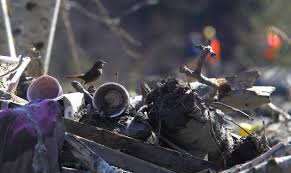
Photo courtesy of KIRO-TV from site of Oso, Washington landslide.
Moriarty
April 11, 2014 - 11:48 am
Whitney,
You’re writing is really good again. This quote, “…a curse spoken by a father has a tendency to stick,” hit home for me as a father. I usually wince after barking at one of my kids.
You also said, “After WWI, it was called shell shock. After WWII, it was battle fatigue. Now it is PTSD. We keep changing the names, but is there a cure?” Perhaps the “cure” is right in front of us. A preventable disaster. John Lennon said give peace a chance. The next time trouble brews and the world turns to the U.S., how about we turn of the porch light and pretend we’re not home? Free a generation from PTSD or whatever it’s named next.
Years ago, I was being given a tour by of friend, of a nursery he had just finished for his not yet born first child. He had painted Noah’s Ark and animals all over the walls. While the two of us were standing in that room he said something like, “Funny that kids love this story so much when it’s filled with so much death.”
Outofwrightfield.blogspot.com
Whitney
April 12, 2014 - 12:39 am
Moriarty –
Giving peace a chance presupposes that humanity has that capacity and can sustain it. We don’t and we can’t.
Reason No. 47 why this world needs Jesus. The hand that dries tears can also end wars.
P.S. Don’t worry about your kids. They are tougher than you know and you are less awful than you think.
Moriarty
April 13, 2014 - 10:47 am
“Giving peace a chance presupposes that humanity has that capacity and can sustain it. We don’t and we can’t.” I don’t like giving up on us. One of my sons is really struggling with pretty much everything; school, family life, social relationships. I can’t give up on him because I’m his father and also a human like he is. If I can’t “not give up” forever on my son, can’t I also not give up on the whole human race?
Moriarty
April 13, 2014 - 10:51 am
I meant CAN “not give up” on my son and humans”
Whitney
April 13, 2014 - 11:02 pm
Moriarty –
Clearly you are doing the right thing. Acknowledging the true nature of humanity doesn’t mean that there is no hope. But starting with truth is imperative.
As to whether we are innately good or evil, there was a great teacher I had in high school, maybe the best I have ever had. William Donahue. He taught me Logic and Humanities. He repeated an ancient question posed by a Greek philosopher:
“If you were invisible, what would you do?”
After a few benign and acceptable answers, the real truth begins to surface from us all.
But this is where hope begins for me. In the midst of our dark hearts, God loves us. We don’t have to try and make ourselves perfect – as impossible as an apple tree growing a mango. He knows us as we are. Instead we give it to Him and He takes care of it.
But it doesn’t just happen. We have to say yes. He honors the free will that He gave us.
Pray for your son. Ask for him to be blessed. Curses spoken by a father have a tendency to stick. The good news is that prayers are more powerful.