Let’s Stay Together, by Martha Thomases – Brilliant Disguise | @MDWorld
January 20, 2017 Victor El-Khouri 0 Comments
Do you ever get sick of listening to your internal monologue? It’s like listening to yourself talk, without the excitement and variety of other people.
My internal monologue sounds a lot like my parents, with occasional input from the women’s magazines of my youth and a lifetime of living in the modern world. What I’ve been noticing lately is how often it reflects attitudes I’ve been unsuccessfully struggling against all my life. Specifically:
• Be thin or boys won’t like you.
• Laugh at their jokes, or boys won’t like you.
• Listen, don’t talk, or boys won’t like you.
• Play down your own accomplishments or boys won’t like you.
Anyone who knows me knows that I don’t obey these rules. I speak up, and I eat fried things, and I am loud. However, the moderator in my head keeps wanting to know if boys like me.
This is a difficult way to live. This is internalized sexism.
And this is something that men don’t have to do. I’m not saying that men don’t have their own self-image issues around attracting women (if women are their thing), but that they have different and more varied measurements of achievement.
I’m also not saying that I suffer more than other women, or that these issues are the only ones that feminism was invented to fight. I’m simply saying that these are the issues that hit most close to home for me.
With the Women’s March on Washington tomorrow (as I write this), I’ve read a lot of mainstream media coverage about the feminist movement circa 2017.
As usual, those in power prefer to keep us divided.
In this article, the schism is supposedly over the issue of abortion. However, to quote from the link, “Reproductive freedom or reproductive justice means that women decide the fate of our own bodies,” Gloria Steinem, an honorary co-chairwoman of the march, wrote in an email message. She said if women “want to make decisions over their own bodies themselves, and want other women to have the same power, then they should feel very welcome at the march.”
I know feminists who oppose abortion. They might be good Catholics, or they might have other reasons. If you are considering an abortion, they might ask if they can talk you out of it. What makes them feminists is that they don’t want to deny other women the legal options to make their own choices. They know that making abortion illegal means that women who disagree with them and want abortions will be more likely to die.
I would argue that women who don’t trust other women to make their own choices can’t be feminists. That said, I am not the Grand Chief Poobah in Charge of Deciding Who is Feminist, so feel free to dismiss my opinion.
The media also enjoys creating tensions between white feminists and feminists of color. In this case, they talked to a white woman who didn’t like a Facebook post. This is from the link: Stung by the tone, Ms. Willis canceled her trip.“This is a women’s march,” she said. “We’re supposed to be allies in equal pay, marriage, adoption. Why is it now about, ‘White women don’t understand black women’?”
While I don’t know Ms. Willis, and therefore can’t ask her what’s going on in her head, my first thought is to say, “It’s not about you.” My next thought was, “Who cares what someone on Facebook says? Her opinion matters as much as yours, and vice versa. Have a conversation.”
Taking my own advice, I read this. A woman of color describes, brilliantly, her frustration with white feminists She’s right. We frequently don’t see our own privilege. We don’t notice the myriad complications other women experience, just as I don’t expect you, Constant Reader, to notice my panicked insecurity about my body.
I acknowledge that my problems are not the most important to anyone who isn’t me. I acknowledge that I am blessed to be an educated woman with a home that’s paid for, friends and family, lots of yarn, and money in the bank. At the same time, I insist that my issues provide me with an opportunity to try to understand yours, whatever your gender, race or other differences.
Too many of us are blind to the things that hurt our fellow citizens. Too many of us, when we fail, look for someone else to blame.
This is a normal human reaction. I do it all the time. For the first few minutes of any crisis, I am looking for reasons it is not my fault.
However, as someone who aspires to be mature, I try very hard not to say any of those reasons out loud. Blame is not useful for solving problems. It just keeps everyone defensive.
If I say something that is hurtful to you as a person, tell me. I might mean to hurt you, but most likely I don’t, and my thoughtlessness not only hurts you, but interferes with my ability to communicate.
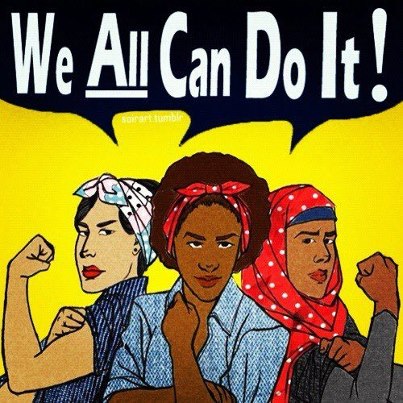
We need to talk to each other so we can march together. And if we disagree, we can have much more interesting conversations as we walk together, side by side.
Martha Thomases, Media Goddess, knows very few actual boys anymore, because most of the ones she knew grew up.
Whitney Farmer
January 24, 2017 - 10:20 pm
M –
Reproductive justice.
I can’t believe I’ve never heard it put that way. I REALLY like that.
Re: body insecurity? That’s what ponchos are for, like the lovely one you posted on FB.