Bill Sienkiewicz and his Little Helpers, by Michael Davis – Straight, No Chaser #203
January 28, 2011 Michael Davis 13 Comments
 A long time ago in a galaxy, blah, blah, blah…
…Denys Cowan, Bill Sienkiewicz and I shared a studio next to some creators who are all legends now. It was the second silver age of comics and we were in the thick of it.
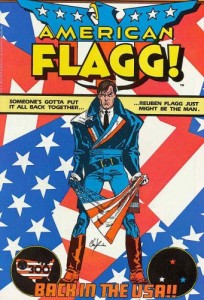
Howard Chaykin was doing American Flag, Walt Simonson was on Thor, Al Milgrom was doing Spider-Man. Jim Sherman was in the studio but I forgot what he was working on, I do remember it was BAD ASS.
The studio where all those superstar upstarts were was called UPSTART STUDIO.
Duh.
Also at Upstart was Frank Miller who was doing Daredevil and about to do Ronin. I seldom saw Frank but when I did more often than not he would ask what I was working on and was just a great guy. I remember being a bit jealous when Bill and Frank started working on Electra and for the life of me I can’t remember why.
All that said-how’s that for a line up?
Those guys (Denys included) sounds like a comic fan’s dream team even now. Speaking of my best friend Denys a few years forward in time from our studios days would see him nominated for an Eisner for best penciler, TWICE. People forget just how badass Denys Cowan is.
Our studio never got an official name although Bill liked to call it, Bill and his little helpers-the bastard.
As far as what we were doing at ‘Bill and his little helpers Studio’ Bill was working on Electra and the New Mutants; Denys was doing The Black Panther for Marvel, V, (the comic adaption of the original TV series) and Vigilante for DC.
What was I doing? Nothing great in comics, that’s for sure.
I was working on children books, movie posters, etc. I had ONE comic book assignment for the Marvel magazine Epic. The assignment was given to me by the late great Archie Goodwin. I made an appointment with Archie hoping for a cover assignment I never dreamt he would give me an interior job.
I LOVED comics but I was trained as an editorial and mainstream illustrator. I never learned to do comics like say a Denys Cowan who can imagine and draw anything from his head. I need reference, I need to look at stuff, and I need dozens of layouts before I start a finished piece. Comics that are fully painted and tell a non-liner story at that time were rare. I was always jealous (still am) of guys that can do that make it up from nothing jazz.
Dwayne McDuffie recently commented on multitalented guys that can write and draw. Truth be told Dwayne, just as a writer is light years away from where I will ever be as a visual storyteller. THAT to me is multitalented. When Christopher Priest was the editor on the Spider-man book he once dissected a cover painting I did for him like he was a high school science teacher and I was the frog. He’s also a hell of a writer and just as good a musician. Reggie Hudlin glides between producing and directing movies and TV shows to writing some of the best comics I’ve ever read. THOSE guys are multitalented.
20 or so years ago, except for Heavy Metal and a few other outlets, painted comics were few and far between. The Graphic Novel as a fully painted editorial piece of art and content was not quite there yet. It was about to come into it’s own lead by people like my brother from another mother Bill Sienkiewicz. The work of Kent Williams, George Pratt and Dave McKean was just around the corner as well but not there yet.
Howard Chaykin saw over 20 years ago where comics were going and produced a few painted books before just about anyone did.
Like an asshole-I tried to do comics the way Denys, Walt, Howard and Frank did. I was too stupid to listen to Howard Chaykin when he told me, “Do what YOU do, the industry is changing and you can bring something new to it.’
Some of the best advice I’ve ever given. It’s right up there with, put your hands on the wheel and answer in a civil tone of voice, “Yes officer, whatever you say officer.”
I wish I was joking about the cop advice but I assure you I’m not.
I did not listen to Howard. Years later Mike Gold told me the same thing after I delivered a Wasteland story, which was not my finest hour. I didn’t think he would but Mike gave me another Wasteland story and said, “Do this like any other illustration assignment.” The story was about South Africa and I nailed that mother.
Of all the high profile regular illustrations gigs I was doing, (Newsweek, NBC, etc) the assignment I was the most excited about was Epic. It was a six-page story I was writing and drawing and taking forever to do because I wanted to do it like ‘regular’ comics artists did. Could not do it then-can’t do it now.
Long story short, I will never forget those late night talks with Howard, Bill, Frank, Jim, Al and Denys. It was indeed the second silver age but for me it will always be my golden age.
Bill and his little helpers. Somehow that does not brother me anymore.
Yeah, I know this is pretty damn sappy.
That’s OK, sap is the new black.
Martha Thomases
January 28, 2011 - 6:53 am
Back in the day, John and I interviewed some of the Upstart guys for HIGH TIMES magazine. As I remember it, we brought our baby with us, in a Snugli. Needless to say, skip ahead a few decades, and I ran into Frank Miller with my now grown (more than six feet tall) son, and his eyes goggled.
Were you there? I don’t remember. But then, it was HIGH TIMES.
MOTU
January 28, 2011 - 7:08 am
Not sure if I was there, but all the cool kids read High Times!
Felix Serrano
January 28, 2011 - 9:16 am
Seems like life repeats itself, or you tried to recreate your nostalgia through your own studio. either way, it’s all good shit. I think it’s safe to say we’re both thankful for the artistic petri dishes we were put in. They helped to forge us as creators.
Russ Rogers
January 28, 2011 - 12:13 pm
The period you describe was the heyday of comics as far as I’m concerned. Chock full of new ideas, and better yet, exciting stories. It not only had the vigor or great artists creating great works, but it was also the dawn of a new era of creator ownership and control. That’s cool. You have every reason to be more than a little nostalgic and even sappy about it.
Marc Fishman
January 28, 2011 - 1:47 pm
It’s interesting that you mention your process MOTU. As I consider myself a digital artist first and foremost these days.. I too work as a “traditional” illustrator. When I do work for Unshaven Comics, I need reference for sure. And because I work digitally, I like to keep layouts loose enough that I can change them if I need to. Unshaven Comics, albeit built around just being best friends… has slowly worked it’s way into a real groove.
Matt is our traditional comic man, able to whip out concepts without reference. I am the cover man, letterer, colorer, and writer of swank dialog. And Kyle is the master planning writer. Our issue 1 of Disposable Razors was a real lesson to learn. Issue 2 came easier, and has bigger moments to it, artistically speaking (and debuts in march!). And issue three will be a hell of a ride.
If only WE sat next to Denys, Howard, and the MOTU.
Bill Mulligan
January 29, 2011 - 6:05 am
I’m with Russ–that was, if not the high water mark for comics, definitely in the top 2 or 3 periods.
So…what the hell happened? Seriously, why didn’t it last, why didn’t it get even better?
MOTU
January 29, 2011 - 4:22 pm
Bill,
Just my opinion but I think one of the major reasons the silver age died was the work was done so well and SELLING so well that publishers ( I think Dark Horse was the exception) lost sight of producing good stories, well told and simply started going for the buck.
Again this is just my opinion. If anyone knows the real ‘why’ it’s Mike Gold for sure.
Mike?
Bill Mulligan
January 29, 2011 - 5:26 pm
I think you are definitely on to something.
You know, I never had to work for Jim Shooter, so this may be awfully easy for me to say, but it seems like things went downhill at marvel after he left. It may just be that his reign coincided with my maximum interest in comics, right time right place, but there was a point when I would buy or at least try EVERY single series marvel made. Unthinkable now, and not just because I’d need to take out a second mortgage.
Mike Gold
January 30, 2011 - 6:46 pm
For me, Upstart Studios was one-shop stopping. Every time I came into NYC, which was at least four times a year, I spent at least a day there — and not just to work on American Flagg, which Howard and I did mostly on the telephone (pre-email, you know). So many of my friends, all in one convenient place in the historical (read “cheap”) Garment District.
Frank Miller and I would spend half a day talking Japanese movies. This was before they became a big deal, and it just so happened I lived near a place in Chicago that screened them to a largely Japanese audience. So I became a huge Zatoichi fan, and Frank, artist Doug Rice, and my actor/stuntman roommate were the only Zatoichi fans I knew at the time.
Guys came and went. Jim Starlin was there for a while. Lynn Varley was there as well; she was Flagg’s first colorist and the competition between Frank and Howard over who would have the bigger hit (Ronin or American Flagg; we won) was literally soul-crushing. Since Lynn was hooked up with Frank, she would up quitting Flagg.
My recollection is that the turnover was faster in your room. I don’t recall meeting you there, but that’s where I first met Denys, I think. And some folks moved from one room to the other, although maybe that was a temporary convenience. Anyway, it was wonderful fun for me every time I came into town.
I think Russ is right — it was a great, great time for new ideas, new energy, and for the Baby Boomers to show what they could really do without the limitations of DC and Marvel (and I don’t mean that maliciously; they do what they do: superheroes, and that’s fine.)
It died because the distributors started running into serious trouble. They stopped over-ordering for reorders (I was once taken to Cap City’s warehouse in Madison and saw the “Ronin” room and then the “Thriller” room; boxes and boxes and boxes of unsold stuff). They started delaying payments to the publishers. They started going out of business. And this is long before the bottom fell out of the market in, what, 1993.
Direct sale comic books is a pyramid scheme that folds onto the publisher. Each month, your sales on a specific title will go down: that’s the dynamic of the comic book shop where you order 10 one month, sell 9, order 9 and sell 8, etc. In order to make their nut, publishers had to constantly add more titles. Because the revenue was going down and the payments coming in later, these newer titles were being produced by newer and less expensive talent. Since the retailers never heard of these new guys, their orders were smaller so the cycle perpetuated itself and spun harder.
Seeing us as a genuine threat (DC took an ad out in their own books noting their triumphs on Amazing Heroes’ Top Titles of the year list, and First Comics had four in the top ten!), DC and Marvel started flooding the market with reprints and revived titles that didn’t sell the first two or three times (how often can you resurrect Kull and even Doctor Strange?) and since retailers had to order their books — Marvel moreso than DC — there was less money for retailers to spend on the so-called independents.
The collectible nonsense didn’t help. Alternate covers, holo-foil, Zero issues (I wanted to do a Pi issue for Image, but they didn’t get the joke and vetoed it)… all sorts of crap that had nothing to do with telling good stories started eating up the shelf space and retailers made more from “investors” than they did from readers. So the readers got hind teat, and they started cutting back once they developed a sex life.
And then the largest distributor went blooie, pushed into oblivion by the bankruptcy of a nine-store chain in Texas and Florida. I wonder what ever happened to that retailer? Oh, yeah… he’s Senior Vice-President of Marketing for DC Comics!
And then. Right then. DC and Marvel started putting serious money on the table. Woof.
Quite frankly, there was another reason: some of the publishers simply weren’t smart enough to meet these challenges. What they didn’t have in revenue (I say “they” because by 1986 I had returned to DC, where the publisher didn’t seem to mind paying freelancers) they had to make up for in smarts and courage, and a couple were lacking in either or both.
One thing more. About Chaykin’s painting.
You know, Howard’s colorblind.
MOTU
February 2, 2011 - 5:51 pm
Yes- I knew that. He told me that and I asked how he did what he did- his answer, “I read the labels on the tube.”
That should be the dictionary entry under bad ass.
We most likey missed each other at the studio because I did extended periods at my home studio and I would more than likely be at ‘Bill and his little helpers’ midnight to the next morning. I cannot believe I missed meeting you there.
carlos franco
February 3, 2011 - 4:06 pm
Mike, i cannot believe you left out that legendary studio feet of herculean proportions: Sienkiewicz, Denys and yourself drew an ENTIRE NEW MUTANTS ANNUAL – IN A WEEKEND!
And you are a very brave man, knowing every single one of your students are up here… and yet you brazenly referred to yourself as “the frog!” lmao mike
MOTU
February 3, 2011 - 5:08 pm
Carlos,
BILL drew the entire thing in a weekend, Denys and I helped on the inks but Bill did every single panel and the majority of the ink work. To this day cannot believe just how fast AND good he is.
carlos franco
February 11, 2011 - 2:15 pm
wow. that dude is the closest thing to a real life marvel. shit. lmao