Outta Space… By Whitney Farmer – Un Pop Culture
November 2, 2011 Whitney Farmer 10 Comments
 Whitney runs a rock music venue on the beach in L.A.. She has an M.B.A, and has Santa Ana winds today.
There is a thin distinction between being a hoarder and being Swedish. The promise of stylish and high density organization provided by IKEA shifts the event horizon on when stacks of stuff can begin to create their own gravitational force and become black holes. Not even light can escape. But on the (symbolic) bright side, the components from the Swedish company help us archive our lives in lipstick colored shelves that reach to the ceiling (even if blonde clerks refuse to take old currency at the checkout just like bars in L.A.). The newly created trails in rooms let us access touchstones to our past or launch new projects that can open new futures, (or impede our movement yet again…).
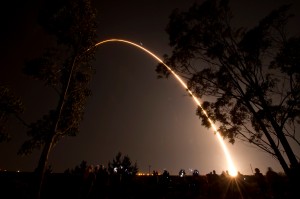
My rocket scientist brother-in-law Buzz is visiting after working on the launch team at Vandenberg AFB that just sent the last Delta rocket into space. At his desk in the control room with countless computers and three cans of Coke, he helped push the complex payload through the sky made crystal clear from the Santa Ana winds that had come through the day before. Photos from the 2:48 a.m. launch showed a perfect event and the beginning of an important mission. The Delta carried with it a satellite that will monitor climate change and weather patterns, and provide data that can be used to improve forecasting. The satellite, built through a collaboration that includes Ball Aerospace that began as a midwest America company that made canning jars for our great grandmothers, can also provide irrefutable evidence about the impact of humanity on our fragile ecosystem. Scientists and engineers such as Buzz have expertise that isn’t corrupted by politics that allows plausible deniability of global warming. They are too busy building marvels that can answer mysteries.
I gave him a tour of the new place and nervously watched his reaction to my attic domain. It suits me, but Buzz is a completely different breed. He can fix anything that is broken, can organize any problem into manageable steps, has no dust in any corners, and can swim farther than most people can walk. Our family looks to him to remind us what we’ve done after time together: During the move, I found an undeveloped roll of film from a Kodak from maybe twenty years ago and am looking forward to seeing what is on it. Conversely, Buzz has his photos captioned, archived, and distributed to everyone in the family within three days tops after landmark family events. And all of his pictures are museum quality.
The team from IKEA had just finished delivering and installing my new platform bed that raises my mattress nearly to the ceiling. Beneath it, I am setting up my office area. The clearance between my mattress and the plaster above has earned the description Chilean Coal Mine. It sways a bit after I climb up the ladder, but the rocking helps me sleep.
Buzz observed the inner space in the upper room as keenly as if it was outer space. Then he issued his opinion:
“This is maximum utilization.”
Given by a guy who launches payloads into the cosmos, this was exactly what I had hoped to hear. There is a sign posted in the IKEA showroom that says that learning to live in a small space is the most compassionate and wise choice that can be made. It means that we value those who live beside us, and that we are humble in how we live. Using everything that we have carefully and well speaks to the engineers and the saints in all of us.
Now, the satellite that was built by a cooperative effort that includes a company that helped our grandmothers keep food from going to waste will be orbiting above and speaking to us about our world which just hit a population of 7 billion people on October 31st. It wasn’t until just 200 hundred years ago that the global population had reached 1 billion. As our decisions cause the biosphere to react with groaning or healing, the satellite launched on the last Delta rocket will record these events like the rings of great trees that also bear witness. The information it can give will help us organize our piles of mess into good decisions about our beautiful planet, or record the events as creation has had enough of our selfishness and whips up hurricanes in an attempt to jettison us off this lovely blue globe and into the cosmos.
—-
Quote of the Blog, from Ingvar Kamprad, Founder of IKEA: “Waste of resources is a mortal sin…”
Mike Gold
November 2, 2011 - 3:30 pm
Wait. What? You have a rocket scientist brother-in-law named Buzz? Damn! How cool is that!
Moriarty
November 2, 2011 - 4:37 pm
Whitney,
I read where people are saying that this planet cannot sustain 7 billion people. But if you could go back to when we reached 5 billion, or 1 billion, or even 100 million, people probably said the same thing about those numbers.
I wonder how much some of the different religions encouraging their members to procreate so they can outnumber their counterparts are driving this.
Circumstances are forcing me to downsize and frankly, I’m looking forward to it. When I was a kid there were eight of us in a 1,400 square foot house (Even just one bathroom for several years). My strong relationships with my four brothers and sister seem the exception to those of my friends who grew up in affluence.
JosephW
November 3, 2011 - 1:54 pm
@Moriarty: I’m kind of guessing that people were NOT saying that the planet cannot sustain a population of “1 billion or even 100 million” simply because of the eras those planetary population milestones were reached.
The US Census Bureau has estimates of the world’s population ( http://www.census.gov/population/international/data/idb/worldhis.php ) and the summary suggests that the world’s population likely first hit the 100 million mark about 500BCE (most of the listed years have a range of population estimates from a variety of sources and even the summary totals often feature a “lower” and an “upper” estimate). Obviously, if you do a little bit of digging through history records, there was obviously vast expanses which could conceivably have sustained a far larger population. (After all, this is just 2 centuries before Alexander the Great is reputed to have wept because there were “no worlds left to conquer”–yet, Alexander failed to march into India and there was a sufficient amount of the Balkan Peninsula that he never ventured into, so obviously his comment was a bit of hyperbole.)
Then, the 1 billion mark was reached sometime early in the 19th century. One source (an early 70s UN report) suggests there may have been between 813 million and 1.125 billion in 1800, but all the sources report in excess of 1 billion by 1825. The 2 billion mark was effectively reached by 1930 and 3 billion is estimated by 1959. 4 billion was reached by 1974 and 5 billion by 1987 and 6 billion by 1999.
Going JUST by “recorded history” (roughly 3000 BCE–pop est at a “mere” 14 million), it took humanity roughly 4800 years to reach the 1st billion milestone and just over another century to reach its 2nd billion. In less than 1 century since reaching the 2 billion milestone, the planet has passed the 3, 4, 5, 6 AND 7 billion marks.
Now, while science and technology have allowed for both massive declines in infant mortality and increases in life expectancy (both of which play a great role in the population increases in just the past 100 years) as well as making it possible for improvements in agriculture, there’s also the indisputable fact that the earth’s land surface (the Netherlands’ reclamations notwithstanding) has NOT expanded to deal with the population increase. Yes, there’s a lot of “empty” land out there, but most of it’s empty for a reason: It simply CANNOT sustain life. Small bands of people living in a desert area (say the Apache and Navajo in the desert southwest) doesn’t mean that MILLIONS of people can live in the same area without creating some sort of adverse ecological impact (look at the number of people who have this absurd notion of having green lawns in their neighborhoods in Phoenix, AZ–there’s simply not enough water resources on hand to sustain such a waste; the Apache and Navajo didn’t seem to care about a green lawn).
Whitney
November 3, 2011 - 7:57 pm
JosephW –
On man…no one told me there would be math. If I edit my piece to say that we hit 1 billion 200-ISH years ago, can I get a pass?
Focusing back on your excellent points, it is relevent to describe not just the quantity of land masses and resources, but also their quality. As you suggested, discretionary choices such as green lawns in Phoenix perhaps need to be reevaluated, ideally before Malthus’ Theory of Population Control begins to show up on the horizon.
And you are so correct in illustrating that we are in a geometric population curve rather than an arithmetic one. If you are talking about company profits, GOOD. If you are talking about constrained resource ramifications, BAD.
Whitney
November 3, 2011 - 8:12 pm
Moriarty –
It sounds like your iron-through-the-fire experience is beginning to reap some steely rewards. Reading what you wrote reminded me of two things from “Dune”.
Paul Muad’dib…”I will face my fear, let it pass through me. When it is gone, only I will remain.”
And…”I will bend like a reed in the wind.” With that, he was able to slay his opponent.
Another Paul (the Apostle) wrote, “I am happy in plenty or in want.” That’s bulletproof.
Side note: One sister and five brothers? That could be really good for her, or REALLY bad. Did she ever have a date successfully run the gauntlet?
Whitney
November 3, 2011 - 8:14 pm
Golden Boy –
I used to have two rocket scientist B-I-Ls. One went crazy though and we released him back into the wild.
Mike Gold
November 4, 2011 - 3:06 am
Did he get his shots first?
Whitney
November 4, 2011 - 4:28 am
Absolutely! I’m very compassionate. I told you I once had pet spiders named Bobby and Susie, right?
Moriarty
November 4, 2011 - 10:04 am
JosephW,
I meant that doomsayers have been declaring for generations that the planet couldn’t survive the next roll of the odometer, yet somehow it does, and we do. Twenty years ago, most people threw everything in the trash, sending it straight to a landfill. Today blue recycle bins are at home, at work, and even at events like fairs, concerts, and probably even NASCAR. (Whitney, I bet you have one at your club that fills with empty bottles of Jack Daniels, and Cabrito Tequila.) How many people could even imagine driving a hybrid car a decade ago, and how many will drive one a decade from now? Yes, it’s ridiculous to have a lawn in Phoenix and I would guess that in the next 10 years most people will have replaced those lawns with rock gardens or plant life indigenous to the area. Ten years after that, I predict lawns will have fallen out of favor across the country, even in Los Angeles. And speaking of Whitney’s humble hamlet; how soon will it be before Angelenos realize they live adjacent to the largest body of water in the known universe, and begin to desalinate sea water? That would free up the water they take from Central and Northern California to make more farms to produce more food for everyone. As other seaside cities follow suit, more water could become available to transform today’s deserts into tomorrows Louisville, CO (Named 2011’s most livable city in the U.S.)
I don’t know how long Whitney’s brother-in-law’s satellite will keep an eye on us, but my money is on it eventually sending good news to those computers surrounded by Coke cans. The good news of cleaner air, smaller landfills, transformed tracts of land, and larger farms.
On the other hand, doomsayers provide a valuable service; they scare us into action. One more Crusade please.
Moriarty
November 4, 2011 - 10:22 am
Whitney,
Frank Herbert also said, “There is probably no more terrible instant of enlightenment than the one in which you discover your father is a man – with human flesh.” That’s the one that is occupying my sleepless nights lately.
Maybe the Fremen could teach a few things about water conservation. I’ve only seen the David Lynch version of Dune, is the second movie any better? Of course it wouldn’t have Captain Picard in it.
Sorry, I have no quotes from that “other Paul.” I can’t quote Scripture or Shakespeare.
My sister married her high school sweetheart. I haven’t had the option for a lot of brothers-in-law, but he was one of the best men I ever met. He never had to run the gauntlet. He was a union carpenter who rebuilt grand pianos and spiral staircases by day, and built and played guitars by night. Cancer took him in ’95. Her second husband was such a great brother to my brothers and me that the “in-law” could have lifted right out. A heart attack took him in ’08. I am brother-in-law-less now.