“Never Ending” #1, by Marc Alan Fishman – Snarky Synopsis | @MDWorld
December 8, 2013 Marc Fishman 2 Comments
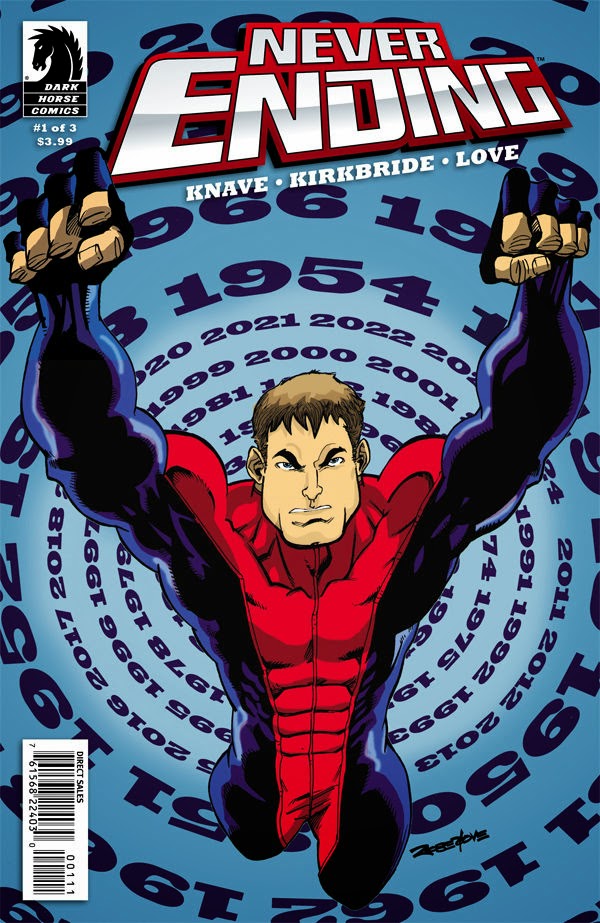 Written by Adam P. Knave and D.J. Kirkbride. Art by Robert Love and Heather Breckel
Preface: I don’t get out much. Seriously. I have a toddler, a wife, a day job, and spend my nights making my own comics, and doing freelance work. Suffice to say… as much as I love our industry, I don’t have an extensive knowledge of all of those within it. Well, beyond the mid-west, I guess. I came into “Never Ending #1” not knowing that writers Adam P. Knave and D.J. Kirkbride were known entities. According to Knave’s personal site… he’s a Harvey and Eisner award winner to boot. Fancy that, because “Never Ending” is one of the most banal and tepid pieces I’ve read in 2013. It’s homage to everything I love in comics, done with a mortiferous dose of monotony.
For a book that is the first of only 3 issues, Knave and Kirkbridge sure don’t care about moving their story quickly. I should note though, the story in and of itself is a retread that I assure you has been told in the modern era of comics no fewer than 1,928,497,209 times. Once again we’re treated to a random meteor landing in a rural area in America and dousing a young, white, good ole’ boy with super-duper powers. What follows? Well, he dons a costume, aligns with the American government, and saves the day a lot. The twist as it were, is that our hero is immortal. Amidst a jumpy retelling of his origins, we see a handful (and a thin and shaky handful at that) of milestones covered; telling his girlfriend about the powers, having a son (no powers), and visiting both of their graves during his “fat and bearded phase” sometime in the future. Seriously, wake me up when we get to the good part.
Oh, the villain! The glorious, original, never-seen-in-a-million-issues villain. It’s a scientist! Who’s evil looking! And he wants to study our hero so he can eventually recreate his powers! And when he can’t? He creates a litany of robotic super suits in order to do battle with his nemesis, and eventually kill him. I just blew your mind, didn’t I? Didn’t think so. I understand, to a point, why Knave and Kirkbridge cling to every major cape trope in the book… but there’s no wink and nod to their prose anywhere in the book. What’s being presented is delivered straight-faced. And because of it? It’s almost insulting. Save perhaps for my toddler son, no one buying this book will be caught off guard.
The lone attempt to change things up: Our hero’s girlfriend, and eventual wife and mother to his child… is black. And yes, that’s new. And yes, the fact that they were dating in the 50’s? Adds a nuance of “really goody two-shoes” to their super man. There’s also an attempt to ensure us that he’s the only hero in the world, and that he recognizes all the tropes that exist (from his uniform to the fact that he’s got no real moniker). But by and large, we waste a full issue getting to the real hook– after a century of doing right by the world, Chuck (yeah, his name is Chuck) wants to commit suicide.
It’s a novel hook. I’ll give them that. But to literally waste a third of this series defining a milquetoast hero, his by-the-numbers nemesis, and then pepper in a few obligatory splish-splashes of backstory? It leaves me so bored that I simply can’t muster the oomph to return for a second or third installment. But I digress. The actual words on the page do nothing more than deliver the exposition. Because so much of this book is clear-cut, squeaky clean, and devoid of surprises… we’re left with prose that doesn’t challenge us where it might have under different circumstances. Case in point? Irredeemable. Read that issue #1, and regardless of the tone difference, you’ll still be reading a Superman knockoff, done amazingly.
Normally, less-than-great scripting can be saved in part by some blow-your-socks-off artwork. It’s the one great crutch of visual sequential fiction. Sadly, “Never Ending” is “Never Astounding”. Robert Love and Heather Breckel are amazingly schizophrenic with what makes it to the page. Chuck himself evolves over time – this I can understand – but is presented with so many physiques… it’s questionable if one of his powers might be a malleable body in addition to the flight and strength. Figures are rendered with a slap-dash pen that had me asking audibly while reading if this was someone’s first attempt. After being let down that the script was turned in by a Harvey and Eisner award winner made it such that I couldn’t bear to google Love or Breckel, for fear they too enjoyed accolades in a previous life. Colors are predictably bright and typical for the story presented. But without so much as a single gradient to a panel (save for a few skies throughout), the old-style hard-cut coloring only further elevates the linework. Linework that is inconsistent, sloppy, and rushed. The only saving grace I could honestly find was superior onomatopoeias littered here and there. Good job, letterer!
Simply put, “Never Ending” makes me question many things. Why it was put out by the same company that gave me an amazing title in “Brain Boy” not a month ago. How a former Eisner and Harvey Award winner and an additional writer could consider releasing 24 pages of regurgitated tropes so engrained in our culture, that easily could have been presented in half as much time without losing a single crappily drawn beat is beyond me. If they would have reached the true hook of the book long before the last page (and far be it from me to dare suggest another trope, but Christ, just come out with it on the first page and work back towards it) I might have had a second thought to stick around. Instead, I have a shining example of how to phone-it-in for a company I myself would near lop off an arm to work for one day. “Never Ending”? Try “Already Read It.”
lorenzo ross
December 8, 2013 - 1:32 pm
I hear you loud and clear Marc and welcome to my world. I have experienced the same frustration you have after reading a title by a major publisher and wondering how this made it to print. I often wonder if cape fans just want more of the same thing but different because that gives them a sense of stability that makes them feel comfortable and safe. I wonder how this book is doing as far as sales.
Marc Alan Fishman
December 8, 2013 - 1:34 pm
Thanks Lorenzo. Lucky for both of us? It’s a big world of snark. 🙂