Justice League 3000 #1, by Marc Alan Fishman – Snarky Synopsis | @MDWorld
January 19, 2014 Marc Fishman 1 Comment
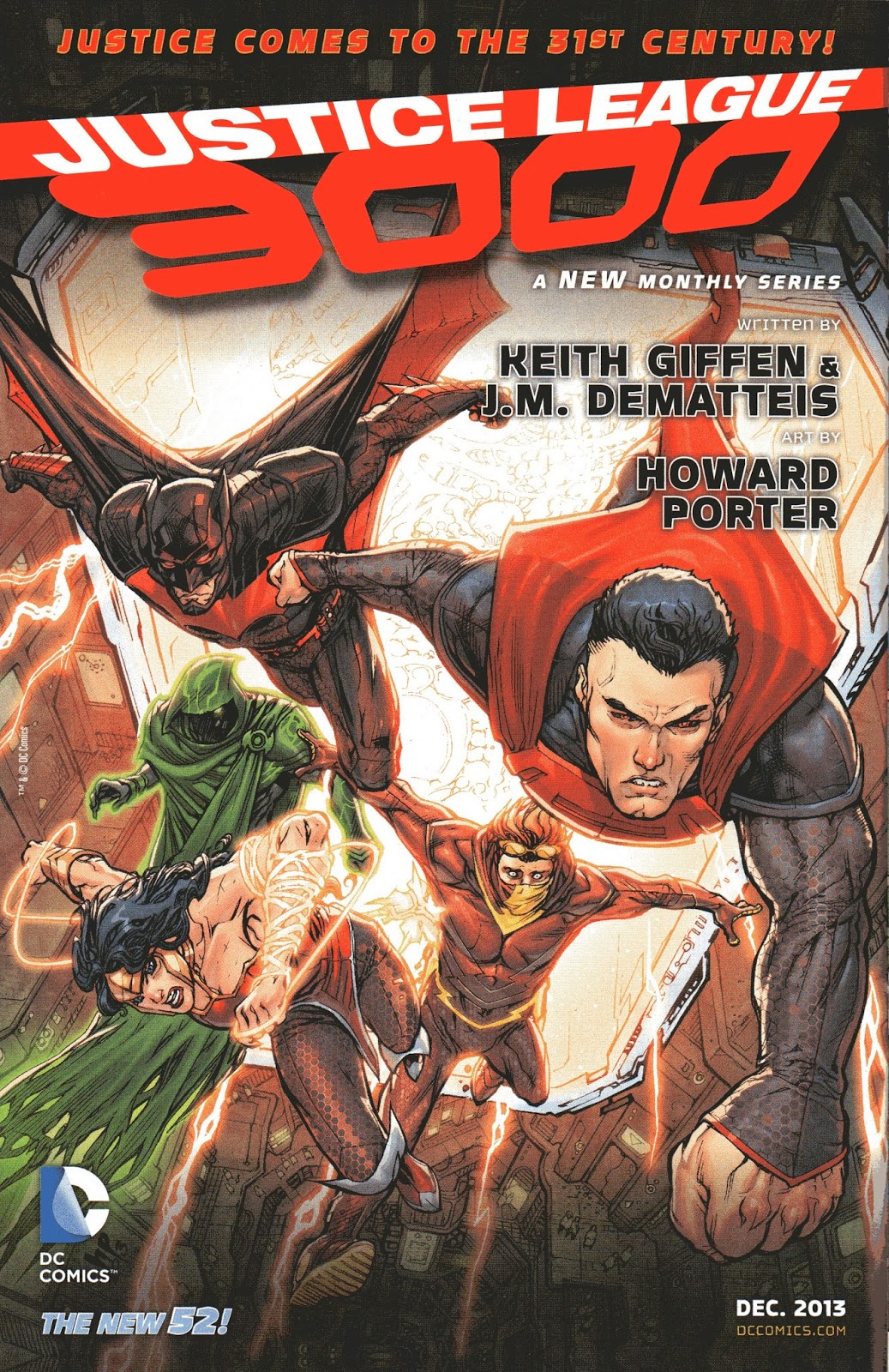 Written by Keith Giffen and J.M. DeMatteis, Art by Howard Porter
After the debacle that was Green Lantern #27 last week, I had little hope that my second go-around for my return to “the big two” (especially DC) would fair better. With that in mind, I looked a bit to the past, and then the future, and chose “Justice League 3000”. Combining the famed writers of some of the funniest and memorable Justice League in the 80’s with the artist from Grant Morrison’s acclaimed run on the League from the 90’s sounded like a solid bet for positive storytelling. Their pitch? A Justice League so far removed from current continuity, there’s no “New 52” stink to deal with. And for what it’s worth? That’s a pitch I was waiting to hear.
One of the most striking differences I enjoyed with this issue was the amount of plot covered in as many pages as last week’s Lantern. Where GL spent a ton of time mopping up the recent past, and few pages trying to define a future… Giffen’s plotting here employs the adage of “jump in late, and leave early” mentality. The result is a book that reads as if it’s in constant motion. The initial scene introduces us to the fugitive Ariel Masters. We then meet the Wonder Twins Terry and Teri, arguing over their recent experimentation, which was once led by Ms. Masters. That experiment? Using the Cadmus Corporation’s secret samples of genetic material of Superman, Batman, Wonder Woman, Green Lantern, and the Flash, and making / growing / cloning themselves up a batch to save the future. And guess what? There’s more plot where that came from!
The rest of the issue introduces us to the titular team of the future. And much to our predictable chagrin, things aren’t as super as they seem. There’s always a knee-jerk reaction to “jerk up” superheroes. Perhaps as a means to shrift the old Legion of Super-Heroes … squeaky-clean image perhaps? Who knows. In any event, J.M. DeMatteis’ dialogue gives us an interesting take on familiar characters. With apparent memory gaps in place, we’re given a Justice League who have only been told they are friends, co-workers, and brothers-in-arms. Because of it, snarky Superman jibs and jabs at Batman at every turn. Wonder Woman seems overtly amazonian in her anger. Flash is less an optimist, and dare I say… quick to judge himself and others. And my favorite Hal Jordan? He’s cloaked, ringless (but not without a reasonable facsimile of his former powers), and an continual suck of life and energy. Hilarious.
The best part of the scripting for me is the intelligent way Giffen and DeMatteis set up their universe quickly, and try to move their story forward. Issue #1’s tend to fall into the same tropes… and when Marvel and DC are as happy as they are as of late to release a near-endless supply of them? It’s nice to see writers that can acknowledge those moments of predictability, and make some attempt to gloss over them. Given that they make the smart assumption that their readers know the Justice League, there’s no obligatory origins necessary. They fact that they start us with Ariel is even a bolder choice. In a book called “Justice League 3000”, it’s shocking that it takes 5 whole pages to even see them. Think about that, kiddos. Nearly a quarter of the book is gone before a bit of the bat, a wisp of the Wonder, or a shred of a Superman. It’s ballsy… except that our writing team is seasoned enough to know not to care. They aren’t without fault mind you – too many cryptic name drops and allusions to problems without any hint of what they actually are – but the strengths far outweigh the failures.
Art duties are handled by the stalwart Howard Porter. As I’d mentioned prior, he’s no stranger to Justice League members. With a long stint on the JLA series proper, he falls right back into his old role with ease. His crowded and kinetic pages match the robust scripting without fail. His future is cramped, crowded, and bathed in rich details. His semi-manga style is a broad blend of great figure-work, emotive faces, and a plethora of line variation. Special credit is due to Hi-Fi, the coloring house, for their superb work. Where I’m apt to rap the fingers of those photoshop-nutballs for drenching today’s books in knockouts, glows, and special flares… in the context of a book set in the year 3000? It not only makes sense visually… it elevates the book to truly feel lived-in for the sets we roam around. It’s refreshing to enjoy the more polished art from a major publisher. When it’s used in this manner? Kudos are well-earned.
Ultimately, “Justice League 3000” #1 is a polished adventure book that deserves a look. Devoid of dour continuity to hamper the storytelling, it’s a breath of fresh air; or it’s a throwback to an era where I was less snarky, and they’re playing me like fiddle. Either way? I dig it. Howard Porter is in fine form. Giffen and DeMatteis deliver a script that combines their wit, wisdom, and wry sense of style into a package so plump with plot, you’ll do a double take when comparing it to other books on the shelf. With potential plot threads now set up, I am for the first time in a long time… hopeful for the future. Lucky for me, 3014 is shaping up to be far more entertaining than 2014.
Whitney
January 20, 2014 - 5:30 pm
It takes a wise man to be more snarky over time and yet more hopeful.
That must be a superhero trait.